Fabricate Pavilion
Project Overview
Fabricate is a small-scale experimental pavilion developed as the first research project of Adapt Group, a collective of young architects and architecture students focused on computational design and digital fabrication. The project investigates the potential of free‑form compression vaults generated through digital form-finding methods and constructed using traditional masonry materials.
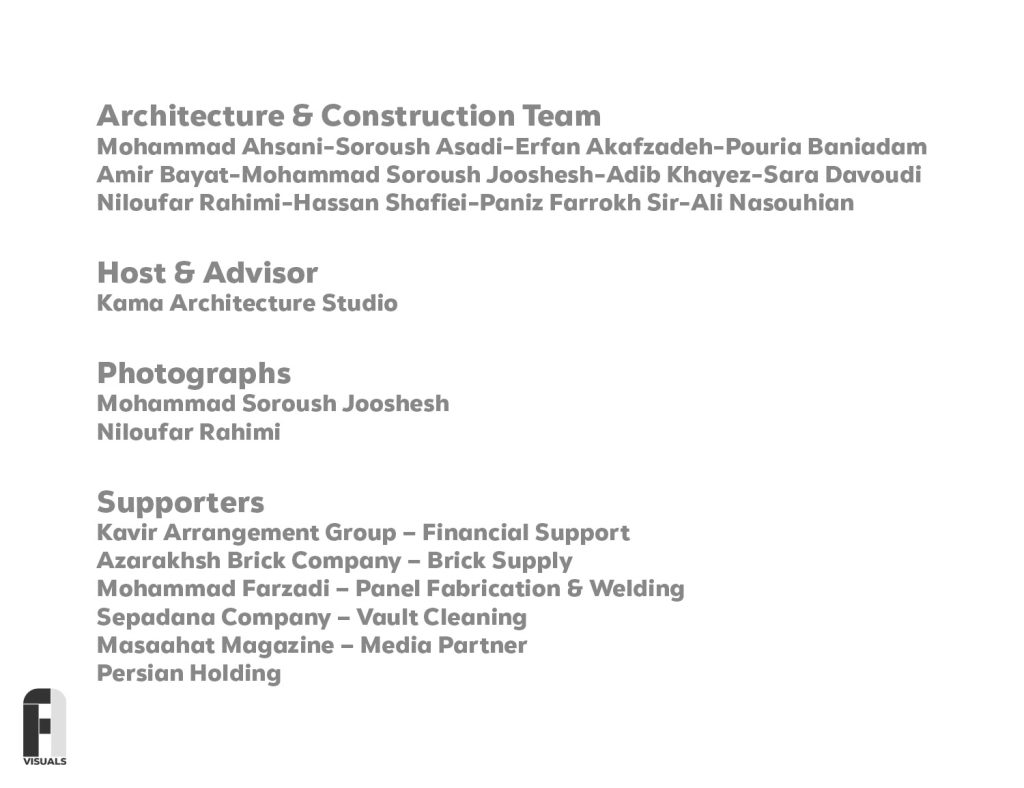
The pavilion was designed and built during a collaborative workshop in Isfahan, hosted and supported by Kama Architecture Studio, which provided the site, logistical support, and coordination for construction.
Concept
Historically, masonry vaults and domes have relied on symmetrical geometries to maintain structural stability because materials such as brick and stone have very limited tensile strength. Their stability emerges from geometries that allow loads to be transferred purely through compression.
Fabricate explores how contemporary computational tools can expand this principle beyond symmetrical forms. By using RhinoVault, a form‑finding plugin developed by the Block Research Group (BRG) at ETH Zurich, the team generated geometries in which internal forces remain entirely compressive, enabling the creation of structurally stable free-form vaults.
The process draws inspiration from Antoni Gaudí’s inverted chain models, where a hanging chain naturally forms a catenary curve under tension. When inverted, this curve becomes an ideal compression form for masonry structures. RhinoVault applies the same structural logic digitally, allowing designers to explore a wide range of stable geometries.
Design Process
The workshop began with a series of internal training sessions to familiarize all participants with the RhinoVault workflow. After initial experimentation, the team divided into several groups to develop design proposals for potential locations within the site.
Each proposal considered multiple criteria, including spatial configuration, circulation paths, structural behavior, constructability, and visual qualities. After an internal review process, one proposal was selected and further refined through iterative structural optimization and analysis.
Although RhinoVault ensures compression-only geometries, the final design was additionally evaluated using structural analysis tools to verify performance under dead loads, live loads, and material constraints.
Fabrication Strategy
A critical phase of the project was the design and fabrication of the temporary formwork used to construct the masonry vault.
The formwork system consisted of:
- A primary waffle structure made from 16 mm MDF panels cut by CNC
- Secondary waffle components made from 3 mm fiber panels in areas with higher curvature
- A reinforcing grid of bent steel rebars placed over the wooden structure to provide a finer support surface for the brick layout
To ensure accuracy in bending the rebars, a full-scale printed guide was used. Additionally, a 1:10 scale physical model was built beforehand to test assembly logic and understand the construction sequence.
Construction
After preparing the site and casting reinforced foundations at the support points, the waffle formwork was assembled on site. The first layer of bricks was then installed vertically, starting from the base supports and progressing upward along the vault geometry.
For the first layer, a mortar mix of construction adhesive, tile adhesive paste, and gypsum (Gipton) was used. Once this layer was completed, the wooden formwork was carefully removed to expose the underside of the vault.
A waterproofing layer was applied to protect the first brick layer from rainwater infiltration. The second and final brick layer was then installed diagonally for improved visual quality and structural continuity, using a mortar composed of cement and stone powder.
After the completion of the second layer, the temporary steel rebars were removed, leaving a self-supporting compression shell.
Significance
Fabricate demonstrates how traditional masonry materials can be combined with computational design tools to create structurally efficient and expressive architectural forms. Compared to conventional vault construction, the thin shell geometry significantly reduces material usage while maintaining structural stability.
The project suggests possibilities for applying compression-based free-form masonry structures in:
- exhibition pavilions
- shading structures
- urban furniture
- temporary or permanent public spaces
By integrating digital form-finding with local materials such as brick, such structures can offer a contemporary architectural language while remaining connected to the historical construction traditions of Iranian architecture.
Location: Isfahan, Iran
Year: Summer 2016
Type: Research Pavilion / Compression Structure
Area: 16 m²
Maximum Height: 2.65 m